
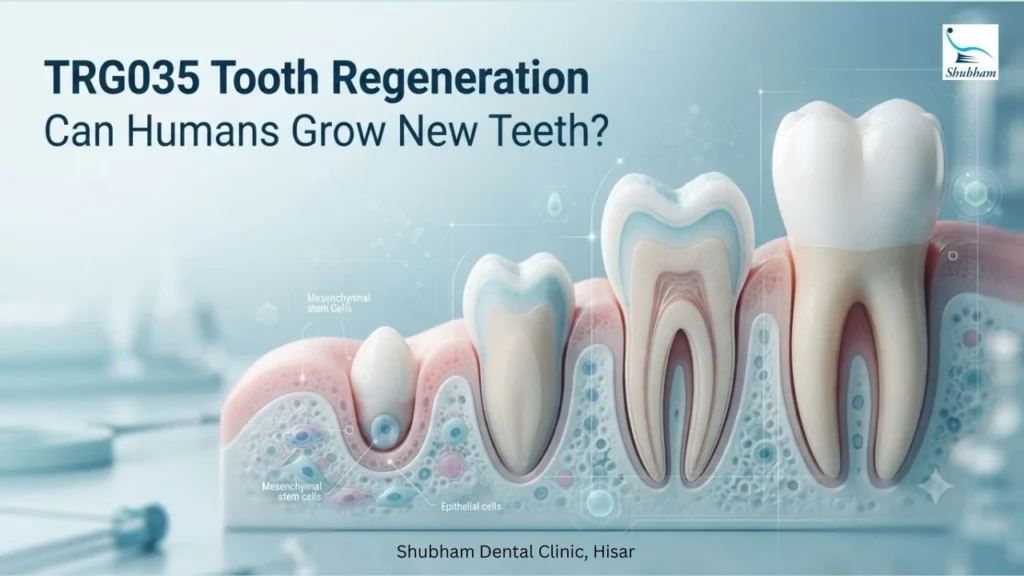
TRG035 tooth regeneration is an area of dental research that is attracting attention in Japan. Researchers are studying an experimental antibody called TRG035 to see whether it can stimulate the body’s own tooth-development process and potentially help form new teeth.
It is an interesting area of dental research, but keep in mind: TRG035 is still an experimental treatment. It has not been established as a way to regrow a lost tooth in routine dental patients.
So what exactly are researchers trying to do, and how close are we to actually growing new teeth?
Key takeaways
- TRG035 is an experimental antibody being studied in Japan, not an established dental treatment.
- Current research focuses on people born without some teeth (congenital tooth agenesis), not people who lose teeth later in life.
- A Phase I safety study has been completed, but further clinical trials are needed before the treatment could have any routine clinical use.
- For now, dental implants, bridges and dentures remain established options for replacing missing teeth.
Research note: This article is based on publicly available clinical-trial records, regulatory updates, and peer-reviewed research on USAG-1 and tooth development available up to October 2026. Clinical research is ongoing, and the evidence may change as new results are published.
What does TRG035 tooth regeneration mean?
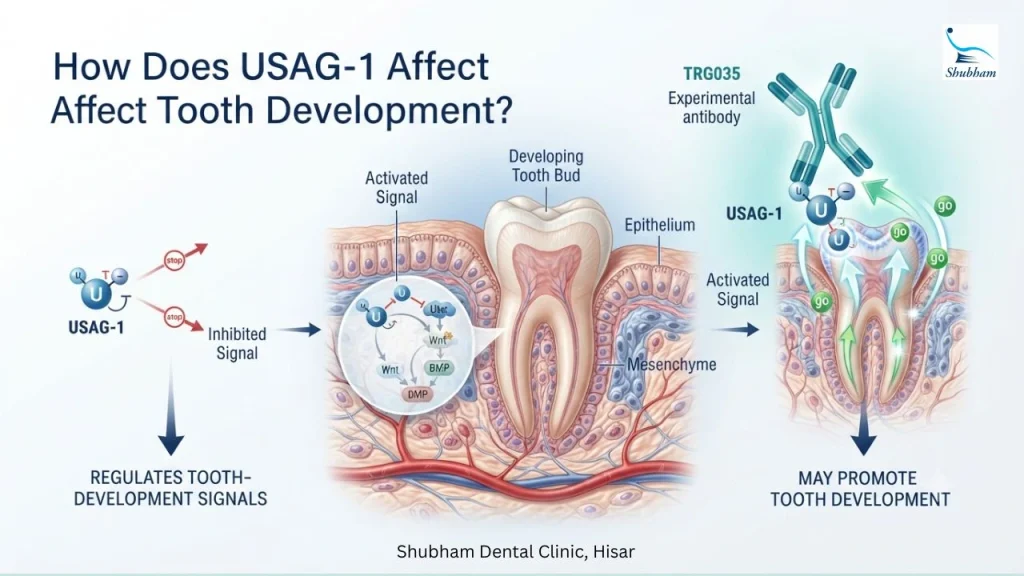
TRG035 is an experimental antibody that targets a protein called USAG-1.
USAG-1 is involved in the biological signals that regulate tooth development. Research has suggested that it can act as a brake on the development of certain tooth germs.
The basic idea behind TRG035 is fairly simple:
Block that brake, and perhaps tooth development can continue.
That sounds straightforward, but tooth development is a complicated biological process. Researchers still need to establish when and how this approach of TRG035 tooth regeneration can work safely in humans.
What does USAG-1 have to do with growing a tooth?
A tooth does not simply appear in the mouth. It develops through a series of carefully controlled biological stages.
During early development, cells communicate with one another through signalling pathways that tell a tooth germ when to grow, change shape and eventually develop into a tooth.
USAG-1 is one of the proteins involved in regulating these signals.
Studies in animals found that blocking USAG-1 could encourage tooth formation in situations where tooth development had been interrupted.
That finding led researchers to investigate whether an anti-USAG-1 antibody could eventually be used as a treatment for people who are born without some of their teeth.
What did the animal research show?
The early research was carried out in animal models.
Scientists found that interfering with USAG-1 could promote tooth development in mice. Further research supported the possibility of using anti-USAG-1 antibodies to stimulate tooth formation.
These results provided the scientific basis for developing a humanised anti-USAG-1 antibody such as TRG035.
But there is an important difference between an encouraging animal experiment and a treatment that works in people.
A result in mice or another animal does not tell us by itself that the same treatment will safely and reliably grow a tooth in a human.
That is why clinical trials are needed.
TRG035 Tooth Regeneration: Has It Been Tested in Humans?
Yes.
Researchers conducted a Phase I clinical study of TRG035 in Japan. The study primarily examined the treatment’s safety and how the drug behaves in the body, rather than testing whether participants could grow new teeth.
The Japanese clinical-trial registry lists safety as the study’s primary outcome.
That distinction is important because headlines about a “tooth-growing drug” can easily give the impression that researchers have already demonstrated tooth regrowth in people.
They have not established that yet.
What is happening with Phase II?
The research has now moved further along the clinical-development pathway.
In August 2026, Toregem BioPharma announced that the Japanese PMDA had completed its investigation related to the notification for a Phase IIa trial of TRG035 for tooth regeneration.
The programme is focused on congenital tooth agenesis—people born without one or more teeth.
This is important because it is easy to assume that researchers are already testing TRG035 as a way to replace teeth lost through decay, gum disease or accidents.
That is not the current situation.
Being born without a tooth is different from losing one later
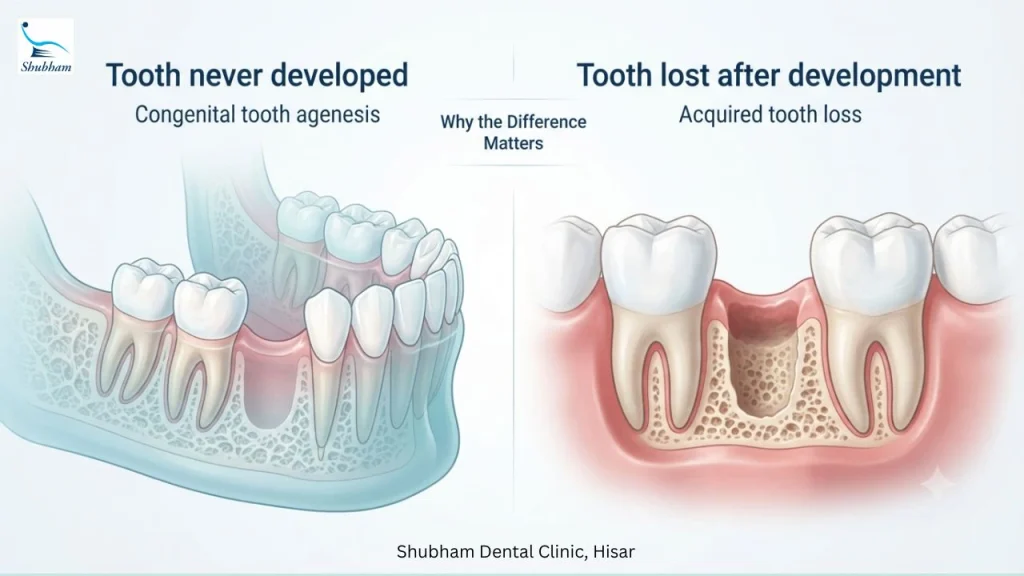
There is a big biological difference between these two situations.
Some people are born without one or more permanent teeth. This is known as congenital tooth agenesis.
Other people develop a normal set of permanent teeth and later lose one because of:
- Tooth decay
- Gum disease
- An accident or injury
- A severely fractured tooth
- Other dental problems
The current TRG035 research is particularly concerned with congenital absence of teeth.
Researchers still need to determine whether the same approach could eventually regenerate a tooth lost years later.
Can TRG035 grow back a tooth that I lost?
Not at this stage.
If you lost a permanent tooth because of decay, gum disease, or an accident, TRG035 tooth regeneration is not currently an established treatment that you can simply receive at a dental clinic.
Research is still underway to find out whether tooth regeneration can work safely and reliably in humans.
There are also several questions researchers need to answer.
For example:
- Can the treatment consistently produce a functional tooth?
- Which patients are likely to respond?
- Can it produce the correct type of tooth?
- Will the tooth develop in the correct position?
- Will the new tooth have normal enamel, dentine, pulp, and supporting tissues?
- What are the long-term effects of the treatment?
- Can it work for a tooth lost after normal development, rather than for a tooth that never developed in the first place?
These are much bigger questions than simply asking whether a drug can make a tooth appear.
Why Is Tooth Regeneration Research Important?
For patients, the most interesting possibility is clear: researchers may one day be able to regenerate a natural tooth instead of replacing it.
Current treatments for missing teeth work very well for many patients, but they are still ways of replacing the missing tooth.
Dentists use dental implants, bridges, and dentures to restore missing teeth.
Regenerative dentistry is exploring a different possibility: encouraging the patient’s own biological tissues to form a tooth.
If that eventually becomes safe and predictable, it could add an entirely new option to dentistry.
But that is still a possibility—not something patients can rely on today.
What about the much-mentioned 2030 date?
You may come across articles or social-media posts suggesting that tooth-regeneration treatment could become available around 2030.
It is better to be cautious with such dates.
Drug development does not follow a guaranteed timetable. Even when an experimental treatment shows promise, it still needs successful clinical trials, evidence of effectiveness, safety evaluation and regulatory approval.
So 2030 should not be treated as a confirmed date when patients will be able to walk into a dental clinic and receive a tooth-regeneration treatment.
The research needs to show what it can actually do in people first.
What should you do if you have a missing tooth today?
If you have already lost a permanent tooth, there is no need to wait for experimental technology before discussing your options.
Depending on your situation, established treatments can include:
Dental implants
An implant can replace the root portion of a missing tooth and support a crown. It may be suitable for replacing a single missing tooth or, in some situations, several teeth.
Dental bridges
A bridge can replace a missing tooth by using supporting teeth or other structures, depending on the condition of your mouth.
Dentures
Partial or complete dentures can replace several missing teeth or an entire arch when appropriate.
The right option depends on factors such as the condition of your gums, remaining teeth, bone, bite, and overall oral health.
A dental examination is the best way to work out which options are suitable.
Should you wait for tooth-regeneration treatment?
This is a question patients may reasonably ask after reading about TRG035.
At present, there is no established reason for someone with a missing tooth to delay appropriate dental treatment simply because tooth-regeneration research is underway.
Research can take years, and an experimental treatment may ultimately work only for particular types of tooth loss or particular groups of patients.
Meanwhile, an untreated missing tooth can affect chewing, appearance and the way neighbouring teeth function or move.
The sensible approach is to discuss your current options with your dentist while keeping an eye on developments in regenerative dentistry.
What could the future look like?
The idea behind TRG035 is one of the more interesting areas of current tooth-regeneration research.
Researchers are studying how the body’s natural tooth-development mechanisms could help them develop new treatments.
The important word is research.
We have promising laboratory and animal findings, an initial human safety study, and further clinical development underway. But we do not yet have enough evidence to say that people who lose a tooth can reliably grow a replacement tooth using TRG035.
That distinction matters.
It is exciting to think that dentistry might one day move from replacing some missing teeth to actually regenerating them. But good science means waiting for the human evidence before turning that possibility into a promise.
Frequently asked questions
Can humans grow new teeth?
Humans normally develop two sets of teeth: primary teeth and permanent teeth. We do not normally grow a third complete set after losing our permanent teeth.
Researchers are investigating whether stimulating certain biological pathways involved in tooth development could help change that situation.
What is USAG-1?
USAG-1 helps regulate signals involved in tooth development. Research suggests that blocking its activity may allow certain tooth-development processes to continue.
Is TRG035 available in India?
No. TRG035 is an experimental treatment under clinical development and is not an established routine treatment for missing teeth in India.
Can TRG035 replace a dental implant?
Not currently.
There is no established clinical evidence that TRG035 can routinely regenerate a tooth lost through decay, gum disease or trauma and therefore replace the need for an implant.
Is TRG035 a medicine that makes anyone grow a new tooth?
That is too broad a description.
The current research is focused on specific biological situations, particularly congenital tooth agenesis. Researchers still need to establish whether and how effectively the treatment can produce functional teeth in humans.
When will tooth-regeneration treatment be available?
There is no confirmed date for routine clinical availability.
Dates mentioned online, including 2030, should be viewed as development targets or projections, not guaranteed availability dates.
The bottom line
TRG035 is investigating an intriguing question: can we use the body’s own tooth-development machinery to grow a new tooth?
The science behind targeting USAG-1 is promising enough to have progressed from laboratory and animal research into human clinical development.
But we are not at the point where dentists can prescribe a tooth-regrowth treatment for someone who has lost a tooth.
For patients in Hisar and elsewhere, implants, bridges and dentures remain the established options for replacing missing teeth today.
For the future, however, tooth regeneration is certainly an area worth watching.
This article is for general dental information and is not a substitute for a dental examination or individual treatment advice.
About Shubham Dental Clinic, Hisar
Shubham Dental Clinic, Hisar, provides general, preventive and restorative dental care under Dr. Rinku Mittal, BDS, with 26+ years of clinical experience.
If you have a missing tooth and are considering your current treatment options, a dental examination can help determine which options are suitable for you.
📞 Call: 9812437844
📍 CUG-63, First Floor, Urban Estate II, Pushpa Complex, Hisar, Haryana 125005